
The Royal Alcázar of Seville is a place where an Eastern fairy tale has remarkably become part of Spain's history. Behind its ancient walls, Arab architecture stands alongside royal palaces, peaceful courtyards and gardens where it is easy to forget that you are in the very heart of modern Seville.
Today, the Alcázar is included on the UNESCO World Heritage List and remains the official residence of the Spanish Crown during the king's visits to Seville. It is one of the few palaces in Europe where each era did not replace the previous one, but instead became part of an extraordinary history that every visitor can see today.
History of the Royal Alcázar
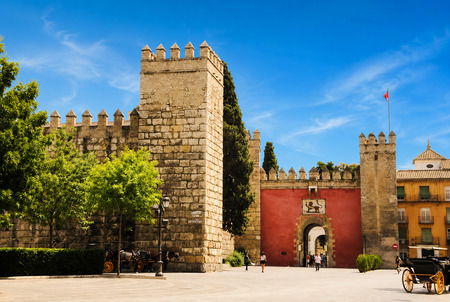
The history of the Royal Alcázar begins more than a thousand years ago. In the 10th century, Moorish rulers built a fortified stronghold here, which both protected Seville and served as the residence of the local emirs. Thanks to its location, the Alcázar quickly became one of the most important political centres of Muslim Spain.
After King Ferdinand III conquered Seville in 1248, the fate of the palace could have been quite different. However, the new rulers did not destroy the Alcázar. On the contrary, they decided to preserve it and turn it into their own royal residence. Over the following centuries, each monarch added new halls, courtyards and gardens to the palace, gradually giving the Alcázar the appearance that amazes visitors today.
For a very long time, the Royal Alcázar remained one of the most important palaces of the Spanish monarchy. Foreign ambassadors were received here, ceremonial events were held and matters of state were discussed. During the periods when Seville was one of the capitals of Spain, the Alcázar stood at the very heart of the country's political life. Today, it is considered the oldest royal residence in Europe still in use.
But history is only the beginning of getting to know the Alcázar. The most fascinating part begins immediately beyond the Lion Gate, where each successive courtyard, hall and garden reveals a new page in the story of one of Spain's most remarkable palaces.
What awaits you inside the Royal Alcázar
The Royal Alcázar is arranged in such a way that your exploration begins gradually. There is no feeling that you immediately find yourself at the centre of a vast palace. On the contrary, each step seems to open a new page of history. Islamic architecture gradually gives way to royal palaces, followed by Gothic interiors, and at the end of the route, green gardens unfold, where it is easy to forget that you are in the very heart of modern Seville.
The Lion Gate — the beginning of the journey
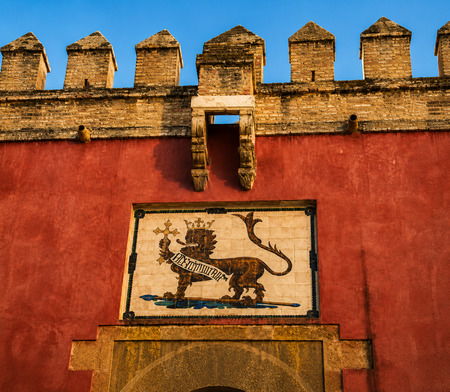
It is through the Lion Gate (Puerta del León) that most visitors first enter the grounds of the Royal Alcázar. It is already here that you realise that what awaits you is not an ordinary museum, but a real historic city behind fortress walls. Above the entrance is a lion with a cross — a symbol that has greeted guests of one of Seville's most famous landmarks for several centuries.
After passing through the massive walls, it is difficult to imagine at first what treasures are hidden inside. The first inner courtyards and ancient walls create the feeling of an old fortress, but with every step the architecture becomes richer and the atmosphere more ceremonial. It is precisely this gradual transition that makes a walk through the Alcázar particularly fascinating.
Patio de la Montería — the main courtyard of the Royal Alcázar
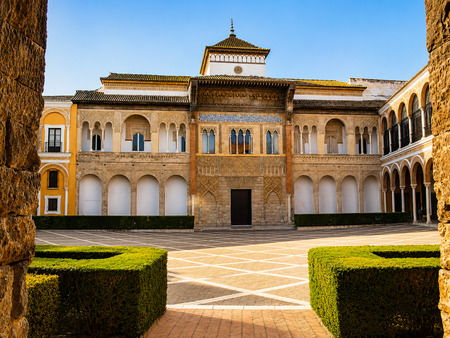
After passing through the Lion Gate, visitors enter the Patio de la Montería — the main courtyard of the Royal Alcázar. It is from here that one of the most recognisable views of the entire complex opens up: before you appears the magnificent façade of the Palace of Pedro I, covered with the finest carvings, Arab ornaments and decorative calligraphy.
It is no coincidence that many consider this courtyard one of the most beautiful places in the Alcázar. It is here that most visitors stop for the first time to admire the palace façade, take photographs and appreciate the scale of the complex. From here, the route to the palace's most famous halls begins, while passages also lead to other historic buildings and the gardens of the Royal Alcázar.
The Palace of Pedro I — the heart of the Royal Alcázar
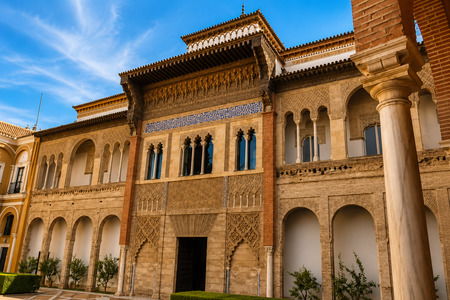
The Palace of Pedro I was built in the 14th century on the orders of the Castilian King Pedro I. The finest craftsmen from Andalusia were invited to build it, preserving the traditions of Islamic architecture. As a result, the palace became one of the finest examples of the Mudéjar style, where Eastern art was remarkably combined with European royal architecture.
As you walk through the palace, your eye constantly catches new details. The walls are covered with the finest stone and plaster carvings, ancient Arabic inscriptions stretch above the arches, the ceilings are decorated with intricate wooden coffering, and brightly coloured ceramic tiles form endless geometric patterns. At the same time, the rich decoration never feels overwhelming — on the contrary, it creates a sense of remarkable harmony that makes you want to spend longer exploring each successive hall.
Hall of Ambassadors — a symbol of royal power
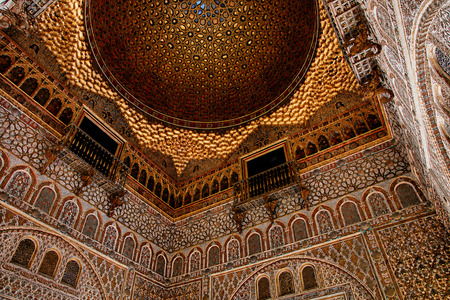
The main room of the palace is considered to be the Hall of Ambassadors (Salón de Embajadores). This was the throne room of King Pedro I, where foreign ambassadors, influential guests and representatives of other states were received. The most important diplomatic meetings and ceremonies took place within these walls, and for centuries the hall remained a symbol of the power of the Spanish Crown.
The first thing that catches the eye is the enormous gilded dome, reminiscent of a starry sky. Looking up, it is hard to believe that such a complex wooden structure was created several centuries ago. It is here that the skill of the architects and craftsmen is particularly striking, thanks to whom the Royal Alcázar is today considered one of Spain's greatest architectural treasures.
The Courtyard of the Maidens — the most recognisable place in the Alcázar
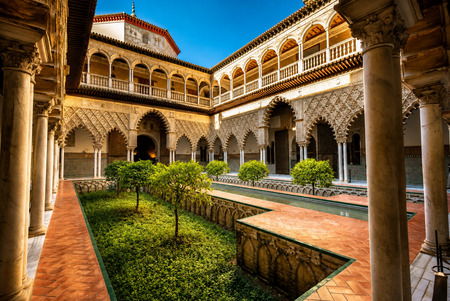
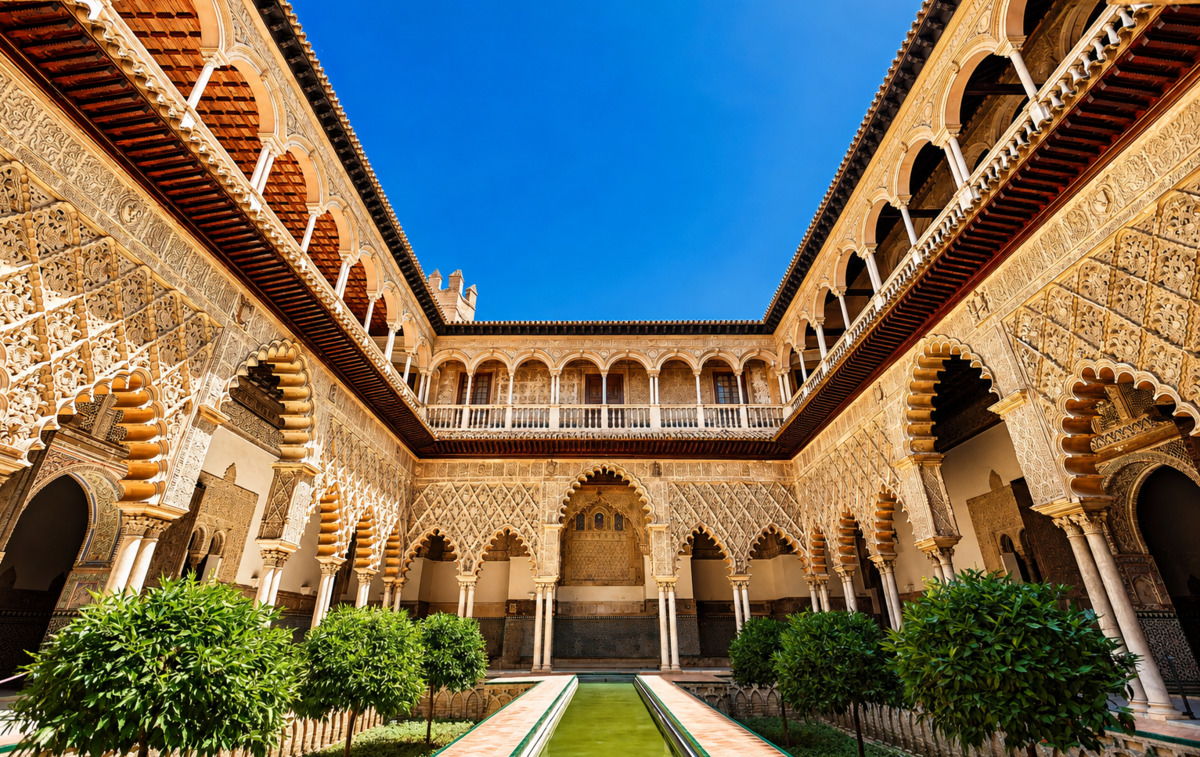
Continuing further through the palace, visitors find themselves in the Courtyard of the Maidens (Patio de las Doncellas) — one of the most famous and beautiful corners of the Royal Alcázar. This is the courtyard that appears most often in photographs of the palace and has long become one of the symbols of Seville. Elegant arcades, reflections in the long pool, intricate carvings and a sense of remarkable tranquillity create an atmosphere where you will want to stay as long as possible.
The name of the courtyard is connected with an ancient legend. According to the tale, the Christian kingdoms of the Iberian Peninsula were required to send one hundred of their most beautiful young women every year to the Moorish rulers as tribute. Historians consider this story more of a beautiful myth than a confirmed fact, but it was this legend that gave the courtyard its unusual name, which has survived to this day.
At the centre is a long reflecting pool, with gardens immersed in greenery on either side. The water enhances the sense of harmony, reflecting the slender columns and decorative arches, while sunlight constantly changes the pattern of shadows. It is here that it is particularly easy to understand why the architecture of the Alcázar is considered some of the finest in all of Spain.
The Gothic Palace — an unexpected change of era
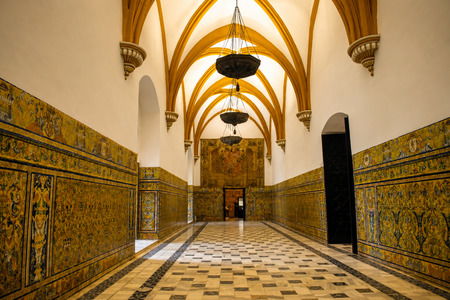
After the Eastern splendour of the Palace of Pedro I and the elegant inner courtyards, the atmosphere of the route suddenly changes. Visitors enter the Gothic Palace, where Islamic ornaments give way to high vaulted ceilings, spacious halls and more restrained European architecture. The contrast is felt literally from the first steps and once again reminds us that the Royal Alcázar was built over many centuries, with each era leaving its own mark here.
Many official ceremonies of the Spanish Crown took place in this part of the complex. Here you will find large ceremonial rooms decorated with tapestries, works of art and historic interiors, while the solemn austerity of the Gothic halls perfectly complements the refined beauty of the earlier palace buildings. Thanks to this juxtaposition, a walk through the Alcázar becomes a journey not only through different architectural styles, but also through entire eras of Spanish history.
The Gardens of the Royal Alcázar
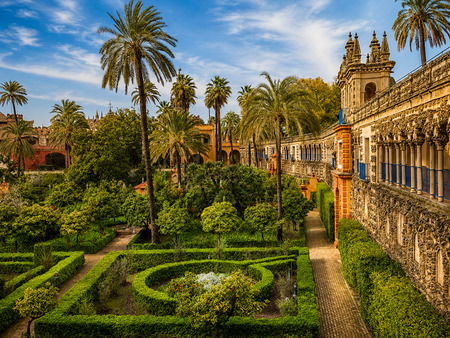
Leaving the palace halls, you will find yourself in the famous gardens of the Royal Alcázar, which cover several hectares and form a real labyrinth of avenues, fountains, ponds, pavilions and shady courtyards. As you walk, the route constantly changes: new gardens, small squares, viewpoints and cosy corners where you will want to stop for a while appear beyond the hedges.
Along the way, you will come across tall palm trees, cypresses, orange and lemon trees, ancient fountains, decorative pools, pavilions, a hedge maze and freely roaming peacocks, which have long become one of the symbols of the Alcázar. It is here that it is particularly easy to forget that the centre of modern Seville is just a few steps away.
The Royal Alcázar and Game of Thrones
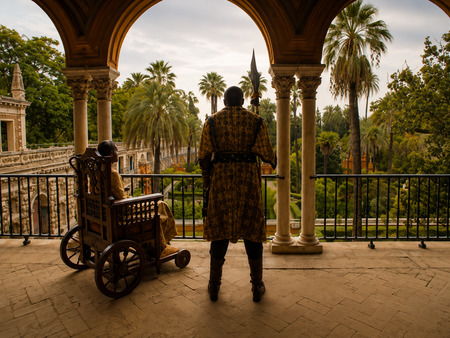
Even if you have never been interested in the history of the Alcázar before, many of its corners may seem surprisingly familiar. It was here that scenes from the legendary Game of Thrones series were filmed, with the Royal Alcázar transformed into the magnificent Water Gardens of Dorne — the residence of House Martell. The series creators hardly needed to alter the palace: its Eastern architecture, inner courtyards and magnificent gardens already looked as though they had been created specifically for the world of Westeros.
During a walk through the Alcázar, you can see several locations that appeared in the series. Among them are the famous Hall of Ambassadors, where scenes featuring Prince Doran Martell were filmed, the Gardens of the Alcázar, which became the Water Gardens of Dorne, the Mercury Pond, where important events of the fifth season unfolded, as well as the mysterious Baths of María de Padilla, used for one of the most atmospheric scenes featuring Ellaria Sand and the Sand Snakes. All of these locations are included in the standard palace tour.
The choice of the Alcázar was by no means accidental. The series creators needed a location that would look luxurious, exotic and believable at the same time. The combination of Arabic architecture, lush gardens, fountains and the Andalusian sun perfectly conveyed the atmosphere of the southern kingdom of Dorne, which is why many scenes were filmed here with virtually no use of computer-generated imagery. Today, fans of the series specifically travel to Seville to follow the same route as the characters from Game of Thrones and see for themselves one of the world's most beautiful palaces, which has become part of a cult story.
Tickets for the Royal Alcázar
The choice of ticket depends on how you want to explore the Royal Alcázar. For some, a self-guided walk through the palace halls and gardens is enough, while others prefer to use an audio guide or choose a guided tour with a professional guide to learn more about the history of one of Europe's oldest royal residences. Combined tickets are also available, bringing together a visit to the Alcázar with other popular attractions in Seville.
The Royal Alcázar is one of Seville's most visited attractions, so when purchasing your ticket, you need to choose your entry date and time in advance. During the peak tourist season, the most convenient time slots quickly become unavailable, so it is best not to delay booking, especially if you are planning a trip in spring, summer or during the holidays.
What else to see in Seville
The Royal Alcázar is located right in the heart of Seville's historic centre, so it is easy to combine it with the city's other main attractions. The Cathedral and the Archive of the Indies are nearby, and after exploring the palaces and the city's history, you can continue your evening with flamenco or head to one of the local markets.
- What to see in Seville — a detailed guide to the city's main attractions, historic districts, squares and other interesting places worth including in your itinerary.
- Seville Cathedral — a magnificent Gothic cathedral with the tomb of Christopher Columbus, the Royal Chapel and the famous Giralda. Together with the Alcázar and the Archive of the Indies, it forms part of a UNESCO World Heritage Site.
- The Archive of the Indies in Seville — a historic building that was once a trading exchange and now houses documents connected with the voyages of Spanish sailors and the discovery and exploration of the Americas. The archive is located literally next to the Alcázar and the Cathedral.
- Where to see flamenco in Seville — a practical guide to tablaos in the historic centre, performances in Triana, intimate venues, peñas and the Museo del Baile Flamenco. An evening performance is a natural continuation of a day spent exploring the historic centre's attractions.
- Festivals and Holidays in Seville — Semana Santa, Feria de Abril and other annual events that vividly showcase the city’s traditions and atmosphere.
- Museums in Seville — art collections, archaeology, flamenco, Andalusian traditions and the city’s unusual museum spaces.
- Street markets in Seville — an opportunity to see the everyday side of the city, discover local produce and experience the atmosphere of different neighbourhoods in Seville.
- Theme parks and family activities in Seville — ideas for a family trip and options for adding some variety to a traditional sightseeing programme.

 English
  Español
  Русский