
Walking along Passeig de Gràcia, it is impossible not to notice the enormous stone building that seems to move despite its impressive weight. Its undulating façade resembles sea cliffs, the wrought-iron balconies look like tangled seaweed, and the extraordinary rooftop with its fantastical chimneys resembles a film set more than an apartment building from the early twentieth century.

At first glance, it is hard to believe that Casa Milà, better known as La Pedrera ("The Stone Quarry"), was originally designed as an ordinary residential building. Yet it was here that Antoni Gaudí was able to bring to life many of the engineering and architectural ideas he had been developing for years. It became his last civil work before the architect devoted himself entirely to the construction of the Sagrada Família.
Today, Casa Milà is a UNESCO World Heritage Site and is considered one of the boldest masterpieces of Catalan Modernisme. Millions of visitors come here not only to see its famous rooftop with its "stone warriors", but also to discover how, more than a century ago, Gaudí created a building that still looks remarkably modern. It feels as though the architect designed it not for the beginning of the twentieth century, but for the future.
The History of Casa Milà

The history of Casa Milà is every bit as extraordinary as its architecture. Today, it is difficult to imagine Barcelona without this building, yet at the beginning of the twentieth century it was met with confusion, ridicule and even outrage from local residents. It was here that Antoni Gaudí completed his search for the ideal residential building, bringing together architecture, engineering and nature into a single harmonious whole.
Antoni Gaudí's Last Residential Building
In 1906, the wealthy businessman Pere Milà i Camps and his wife, Roser Segimon, purchased a plot of land on the prestigious Passeig de Gràcia and commissioned Antoni Gaudí to design a new apartment building with luxurious residences. By then, the architect had already gained recognition through Casa Batlló, Palau Güell and several of his other works, so the clients were prepared to give him almost complete creative freedom.
As mentioned earlier, Casa Milà became Gaudí's last civil work. Construction lasted from 1906 to 1912, after which the architect devoted himself almost entirely to his greatest ambition—the construction of the Sagrada Família. Many of the ideas that would later be further developed in the famous basilica were first tested here: the absence of load-bearing interior walls, natural ventilation, a sophisticated system of inner courtyards, and organic forms inspired by nature.
Why the Building Was Named La Pedrera
Today, the name La Pedrera ("The Stone Quarry") is recognised around the world, but it did not originally begin as the building's official name. Instead, it was a nickname given by the people of Barcelona shortly after construction was completed.
The unusual undulating façade, with none of the straight lines people were accustomed to, struck many as too rough and heavy. Some compared it to a cliff, others to an enormous block of stone, while many openly mocked Gaudí's new creation by calling it "the stone quarry". The architect accepted such criticism calmly, understanding that his ideas were far ahead of their time.
Decades passed, and attitudes towards the building changed completely. Today, the name La Pedrera has become one of Barcelona's most recognisable landmarks. The building is a UNESCO World Heritage Site and is regarded as one of Antoni Gaudí's greatest masterpieces. The story behind its nickname is another reminder that the boldest architectural ideas are not always appreciated at first sight.
What Awaits You Inside Casa Milà
Casa Milà makes a powerful impression from the outside, but the real experience begins the moment you step inside. As you move gradually from one space to another, it becomes clear that Gaudí designed far more than just a beautiful building. He created a home in which every architectural idea was intended to improve the lives of its residents. Here, light, air and space become just as important to the architecture as stone and ceramic.
Inner Courtyards

The tour begins in the inner courtyards, which immediately reveal just how unusually Antoni Gaudí thought. Instead of the dark, narrow light wells typical of apartment buildings at the beginning of the twentieth century, he created spacious open courtyards that allowed sunlight to flow freely into the apartments.
The tall courtyard walls are decorated with murals and rise gracefully upwards, forming what are effectively light shafts. Thanks to this design, almost every room received natural daylight, while the constant circulation of air provided excellent ventilation even during the hottest summer days. For its time, this was a truly revolutionary engineering solution.
Today, it is difficult not to stop for a few moments and look upwards. The light gradually changes, the walls seem to come alive through the play of colours, and the open sky above makes the space feel unexpectedly light despite the building's massive stone walls.
The Historic Apartment
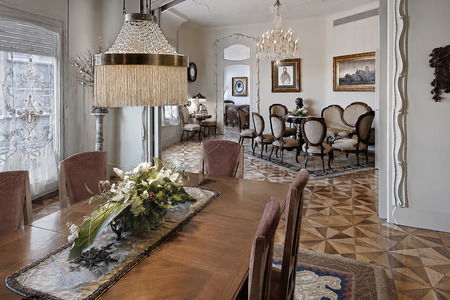
The next part of the tour takes you to the historic apartment, restored to reflect how it looked at the beginning of the twentieth century. Here, you can see how a wealthy Barcelona family lived when Casa Milà first opened its doors to its earliest residents.
The rooms are furnished with period furniture, and the interiors allow you to experience the atmosphere of Catalan Modernisme in everyday life. It is particularly fascinating to notice the details: the flowing lines of the doorways, the unusual ceilings, the elegant window frames and the absence of conventional right angles. Even more than a century later, these rooms still feel remarkably modern and surprisingly welcoming.
It is here that it becomes especially clear that Gaudí was not creating a museum or an architectural experiment, but a genuine home in which every detail was intended to make life more comfortable for its residents. With the help of the audio guide, many of the interior features seem to come to life, allowing you to imagine the daily life of the Milà family and appreciate just how extraordinary this home was for its time.
The Attic
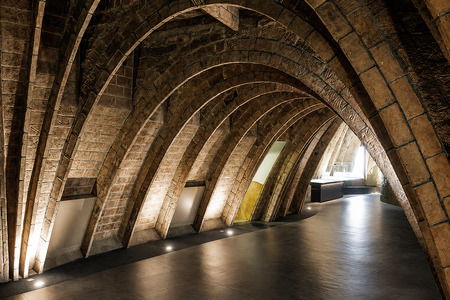
Climbing higher, visitors reach one of the most remarkable spaces in Casa Milà—its vast attic, which today houses an exhibition dedicated to the life and work of Antoni Gaudí. It is here that you truly begin to appreciate that the architect was not only a brilliant artist but also an outstanding engineer.
The space is formed by more than 270 parabolic arches, flowing one after another in perfect rhythm. They are often compared to the ribcage of a giant animal or the skeleton of a whale, as they so naturally echo forms found in nature. Despite the absence of conventional supporting structures, the entire system is remarkably strong and light.
Today, this forest of arches contains a museum exhibition where you can see original models, drawings, photographs and scale models explaining Gaudí's engineering solutions. It is here that you begin to understand how he was able to create buildings that still appear innovative and remarkably modern more than a century later.
The Famous Rooftop of La Pedrera
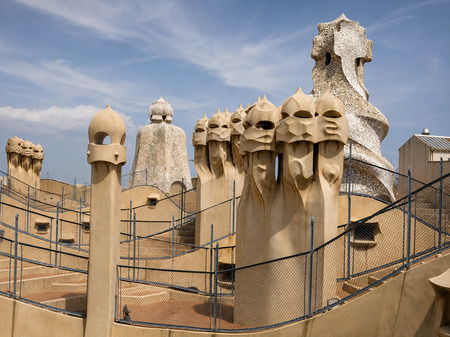
The final part of the tour takes you to the rooftop of Casa Milà—the feature that has made the building famous far beyond Barcelona. Here, ordinary ventilation shafts, stair towers and chimneys are transformed into true sculptures. Some resemble knights wearing helmets, others look like fantastical guardians or characters from ancient legends. Every form is not only visually striking but also serves a practical purpose.
From here, you can enjoy magnificent views over Barcelona, including the Sagrada Família, Montjuïc Hill, the Mediterranean Sea and the Eixample district stretching out in every direction. It is on the rooftop that most visitors take their most memorable photographs, as Casa Milà reveals an entirely different side of itself from this unique perspective.
If you are planning to visit Casa Milà in the evening, it is worth considering the La Pedrera Night Experience. After sunset, the rooftop is transformed into an extraordinary stage for a light show featuring video projections and musical accompaniment. The evening atmosphere makes the familiar architectural forms appear even more mysterious, allowing you to experience Gaudí's famous masterpiece from a completely different perspective.
Tickets for Casa Milà
The choice of ticket depends on how you would like to experience Casa Milà. Most visitors opt for a standard daytime ticket and explore the entire route independently—from the inner courtyards and the historic apartment to the famous rooftop with its futuristic chimneys. Those wishing to gain a deeper understanding of the building's history and Antoni Gaudí's architectural ideas may prefer a guided tour or the La Pedrera Night Experience, during which the rooftop becomes the setting for a spectacular light show accompanied by music.
Casa Milà operates on a timed-entry system, so it is best to choose your visit date and time in advance. Tickets sell out particularly quickly during the peak tourist season, as well as for the evening tours, where the number of places is limited. If you would like to explore the entire building at a relaxed pace, visit the famous rooftop and choose the most convenient time slot, it is best to book your tickets in advance.
What to See After Visiting Casa Milà
Casa Milà is one of Antoni Gaudí's most remarkable creations, but it is when combined with Barcelona's other landmarks that the full scale of his genius truly becomes apparent. After exploring La Pedrera, you can continue discovering the great architect's work, visit one of the city's finest art museums, or take a gastronomic break at one of the local restaurants.
- Casa Batlló — another masterpiece by Antoni Gaudí, located just a few minutes' walk away along Passeig de Gràcia. Together, these two houses reveal how differently the architect worked with form, light and space.
- Sagrada Família — Gaudí's greatest masterpiece, where many of the architectural ideas first explored in Casa Milà were further developed and brought to their highest expression.
- Park Güell — the famous park where you can see how Gaudí united architecture and nature, turning a simple walk into a journey through the world of Catalan Modernism.
- Picasso Museum — one of Barcelona's best-known art collections, dedicated to the artist's early work and his close connection with the city.
- Barcelona's Top Attractions — a ready-made itinerary featuring the city's most fascinating sights, helping you plan a walk for one or several days.
- Where to Eat in Barcelona — the best Catalan dishes, popular restaurants and tips on where to enjoy a pleasant culinary break after exploring the city.
This itinerary will allow you to discover Antoni Gaudí's most famous works, explore Barcelona's artistic heritage, and experience the city's unique atmosphere far beyond its main tourist streets.

 English
  Español
  Русский