
If you work remotely and are considering moving to Spain, a digital nomad visa will allow you to live in the country legally and continue working for a foreign company or clients. It is one of the options available to those who do not want to give up their current remote work after moving.

The programme is intended for citizens of countries outside the EU. To obtain a digital nomad visa, you need to meet the requirements relating to your work, income and qualifications, as well as prepare the necessary documents. Where you are at the time of application also matters: you can apply through a consulate or while already in Spain.
Contents:
Digital nomad visa requirements
In Spain, this type of permit is officially called visado para teletrabajo de carácter internacional — a visa for international remote workers. The name visado para nómadas digitales, or Digital Nomad Visa, is also widely used.
The main requirements relate to the nature of your work, the company, your income and your qualifications.
- Remote work. You must work remotely using digital technologies. If you are an employee, your employer must be based outside Spain. Freelancers may also work with Spanish companies, but this activity must not exceed 20% of the total workload.
- Working relationship. At the time of application, you must have been working with a foreign company or client for at least 3 months. The company you work with must have been conducting genuine business activity for at least 1 year.
- Education or experience. You must have a relevant higher education or professional qualification, or at least 3 years of relevant professional experience.
- Income. In 2026, the main applicant must prove an income of at least €2,442 per month. An additional €916 is required for the first family member, and an additional €306 per month for each subsequent family member.
If these requirements apply to you, you can move on to preparing the documents. In addition to proof of your work, income and qualifications, you will need insurance and other mandatory documents for the application.
What documents are needed for a digital nomad visa
The exact set of documents depends on whether you are employed or work as a freelancer (autónomo), as well as where you submit your application — through a consulate in your country of residence (a 1-year visa is issued) or directly in Spain (a 3-year residence permit is issued).
- Passport — a valid passport. For applications submitted through a consulate, it must be valid for at least 1 year and have at least two blank pages.
- Photograph and application form — a completed and signed application form for a national visa or residence permit and a recent passport-size photograph.
- Employment documents — an employment contract or contracts with clients. You need to prove that the employment or professional relationship has existed for at least 3 months. An employee must also provide a letter from the foreign company authorising them to work remotely from Spain and describing the working conditions.
- Company documents — an extract from the commercial register or an equivalent document confirming the existence of the foreign company and its genuine business activity for at least 1 year.
- Proof of income — an employment contract, payslips, bank statements, tax documents or other documents confirming the required income. In 2026, the main applicant must have an income of at least €2,442 per month. If you are moving with your family, an additional €916 is required for the first family member and an additional €306 for each subsequent family member.
- Degree or proof of experience — a degree in a relevant higher education or professional qualification, or documents proving at least 3 years of relevant professional experience.
- Social security — for an employee, proof that the foreign employer and employee are registered with the Spanish Seguridad Social is required. For an autónomo, registration with the RETA is required. If a social security agreement is in force between Spain and your country of origin, a special certificate confirming continued social security coverage may be used instead of registration in Spain.
- Health insurance — a separate policy is required if medical coverage is not provided through the Spanish healthcare system. In this case, you need public or private insurance from an insurer authorised to operate in Spain, with coverage at the level of the public healthcare system. Ordinary travel insurance is not sufficient.
- Criminal record certificate — a certificate from the country or countries where you have lived during the last 2 years, as well as a declaration confirming that you have no criminal record for the last 5 years.
- NIE — Foreigner Identity Number. Depending on the consulate, you may be able to apply for it at the same time as the visa, or you may need to obtain it in advance.
Official foreign documents must be translated into Spanish and, if required for a particular document, apostilled or legalised. For applications submitted through a consulate, you should also check in advance the requirements of your particular consulate regarding the translation and formalisation of documents.
Before submitting your application, it is important to check the current list of documents specifically for your application method: consulate requirements and the documents required for a residence permit application in Spain may differ.
How to obtain a digital nomad visa in Spain
To apply for a visa or residence permit, you will need an NIE (Número de Identidad de Extranjero) — the Foreigner Identity Number in Spain. The procedure for obtaining it depends on where you submit your application: outside Spain, the NIE is obtained through a Spanish consulate, while in Spain, it is obtained according to the established procedure within the country.
If you are applying through a consulate, check its requirements for the NIE in advance: at some consulates, you can request it at the same time as the visa, while at others it is recommended or required to obtain the number before submitting your application. It is best to start the NIE application in advance so that this procedure does not delay the submission or processing of your application.
After obtaining your NIE, the application procedure depends on where you are:
- Outside Spain — you apply for a digital nomad visa through a Spanish consulate.
- Already in Spain — if you are legally in the country, you can apply directly for a residence permit for digital nomads through the UGE, without first obtaining a visa.
If you are applying from abroad
1. Check which consulate accepts your application.
You need to apply to the Spanish consulate responsible for your place of residence. First, check its current requirements: whether you need an appointment, how documents are submitted, how the fee is paid and whether any additional documents are required.
2. Prepare the application form and documents.
You need to use the Spanish national visa application form. You can download it from the website of the relevant consulate. Complete and sign the form, then prepare the documents proving your employment, income, qualifications, insurance and the other requirements listed above.
If the documents were issued in a language other than Spanish, check the requirements for translation, apostille or legalisation in advance. The consulate may also have additional requirements for how the documents must be prepared.
3. Pay the consular fee.
The amount and method of payment depend on the particular consulate and the applicant's nationality. In some cases, the fee is paid directly when the application is submitted. Before your visit, check the current amount and payment procedure on your consulate's website.
4. Book an appointment and submit your application.
If the consulate operates by appointment, book a date for submitting your application. On the appointed day, submit the application form, passport, photograph and all other required documents.
After accepting your documents, the consulate may request additional documents or invite you for an interview.
5. Wait for a decision.
The official processing time for a visa application is 10 working days. If the consulate requires additional documents or an interview, the processing time may be extended.
6. Collect your visa.
If the decision is positive, the consulate will inform you when and how to collect your passport with the visa. You must collect the visa within 1 month from the day following notification of the positive decision. The digital nomad visa is issued for a maximum of 1 year.
If you are already in Spain
If you are legally in Spain, you do not need to obtain a visa in advance. You can apply directly for a residence permit for international remote workers through the Unidad de Grandes Empresas y Colectivos Estratégicos (UGE). This permit is usually issued for 3 years, provided that the term of your contract is not shorter than this period.
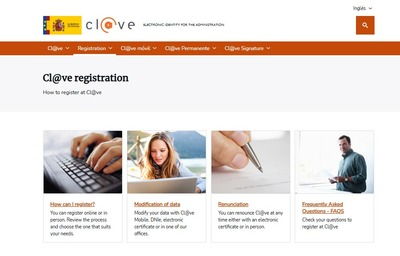
The application is submitted entirely online. To log in and sign the documents, you will need electronic identification — a Spanish digital certificate or Cl@ve. You can register for Cl@ve online or in person at one of the available registration points.
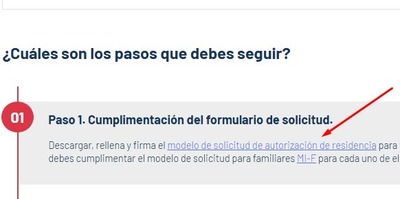
1. Download and complete the residence permit application form.
On the official Plataforma ONE, download the Solicitud de autorización de residencia para titulares (MI-T) form, complete and sign it. If family members are moving with you, a separate MI-F form must be completed for each of them.
2. Pay the government fee.
The application uses Modelo 790, código 038. The current fee is €73.26. Complete the form and proceed to payment — below on the page, you will be offered a choice of available payment methods: through a bank or online using a digital certificate or Cl@ve. After payment, you will receive an NRC (Número de Referencia Completo) — you will need it when submitting your application electronically.
3. Submit your application online through UGE.
After completing the application and paying the fee, go to the UGE-CE electronic system — the official service of the Ministry of Inclusion, Social Security and Migration for submitting applications under Law 14/2013.
Select «Alta de solicitud», enter your details, upload the prepared documents and proof of payment with the NRC, then sign and submit the application.
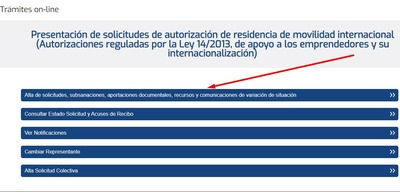
After submitting the application, you will receive a registration number and confirmation of submission.
4. Wait for a decision.
The official processing time for an application submitted through UGE is 20 working days. The decision is sent electronically.
5. Apply for your TIE.
After receiving a positive decision, you need to apply for a TIE — a physical foreigner's identity card. The procedure for obtaining it depends on your place of residence and usually involves making an appointment with the police and having your fingerprints taken.
Where to download the forms and submit your application
Use the official sources for the application:
- Plataforma ONE — information about the digital nomad visa and applying for a residence permit in Spain. The necessary forms and instructions are also available here.
- UGE-CE — online submission of an application for a residence permit in Spain.
- Ministerio de Asuntos Exteriores — the official website of the Spanish Ministry of Foreign Affairs. Here you can find the consulate responsible for your place of residence and check the current requirements, appointments, documents and consular fee.
Taxes and social security for digital nomads
The digital nomad visa itself does not determine your tax regime. If you become a tax resident of Spain after moving, you need to deal separately with income tax.
Digital nomads may be eligible for the special tax regime for workers who move to Spain. It also applies to workers who move to Spain for remote work. One of the main conditions is that you must not have been a tax resident of Spain during the five tax periods before moving. If you meet the requirements, you can choose this regime and apply special IRNR tax rules while retaining your IRPF taxpayer status in the year of moving and the following five tax periods.
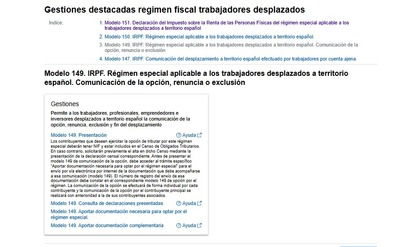
This regime does not apply automatically when you obtain the visa — you need to apply for it separately through the Agencia Tributaria. The Modelo 149 is used for this purpose.
As for social security, everything depends on whether you are employed or work as an autónomo. Depending on the situation, you will need to register with the Spanish Seguridad Social system or provide a document confirming that you can remain covered by social security in your country of origin, if this is provided for by an international agreement.
It is best to check the detailed conditions of the tax regime and the application procedure directly on the Agencia Tributaria website, as tax rules may change.
Can you move to Spain with your family?
Yes, you can. If you obtain a digital nomad visa or a residence permit for a remote worker, your spouse or partner and children can move to Spain with you. A separate residence permit is issued for each family member.
You can apply for your family at the same time as the main applicant. When applying through UGE, a separate MI-F form is completed for each family member, while applications through a consulate must follow its requirements for family applications.
If you are moving with your family, you will need to prove additional income. In 2026, the minimum income of the main applicant must be supplemented by €916 per month for the first family member and a further €306 for each subsequent family member.
An important point: family members also have the right to work in Spain — both as employees and independently.
Therefore, if you are planning to move to Spain with your whole family, it is better to prepare the documents for your family members at the same time as the main application.
Useful to know before moving to Spain:
- NIE in Spain: how to obtain one and what documents you need — how to obtain a Foreigner Identity Number and what documents you will need.
- Address registration in Spain (Empadronamiento) — how to register your address and obtain a certificado de empadronamiento.
- Pros and cons of living in Spain — what to consider when moving to and living in the country.
- Cost of living in Spain in 2026 — costs of housing, food, transport and everyday life.
- Property prices in Spain — housing prices and the main costs involved in buying property.
- Mortgages in Spain — how foreigners can get a mortgage and what conditions apply when buying property.
- Driving licences in Spain — how to exchange or obtain a driving licence after moving.
- Parking rules in Spain — what you need to know to avoid parking fines.
- Fines in Spain — common offences and what you need to know after moving.

 English
  Español
  Русский