
The Museum of Illusions in Madrid is one of the city's most unusual attractions, where the main exhibits are not paintings or historical artefacts, but the visitors' own eyesight, brain, and imagination.
Sometimes it is genuinely hard to believe what you are seeing. A room where a person suddenly appears to become a giant. A tunnel that makes it feel as though the ground is disappearing beneath your feet. Mirrors creating endless reflections, and optical illusions that make you look at the same object again and again. Before long, you find yourself wondering: "How is this even possible?"

The Concept Behind the Museum of Illusions
Unlike traditional museums, there are very few exhibits here that are simply meant to be observed from a distance. Most of the installations are designed for interaction: you can explore them, photograph them, experience them first-hand, and work together to understand how they function. Every room becomes a small experiment where science, optical effects, and the fascinating workings of the human brain are transformed into an entertaining game.
This concept forms the foundation of the international Museum of Illusions network, which brings together dozens of museums around the world. The Madrid museum opened in the city's historic centre and quickly gained popularity thanks to its unique format, which appeals equally to children, teenagers, and adults. Here, visitors can not only be amazed by what they see but also discover why the familiar rules of space, perspective, and perception are sometimes very different from what they appear to be.

As you make your way through the museum, you gradually move from one illusion to another. First, you are amazed by the unusual visual effects, then you begin experimenting for yourself, and by the end of your visit, you realise that you are looking at ordinary things in a completely different way. That is why a visit to the museum is remembered not for any single exhibit, but for the constant sense of discovery that accompanies you almost every step of the way.
What Awaits You Inside the Museum
The Museum of Illusions has been designed so that every room offers a different surprise. There is no single correct route or lengthy guided explanations — it is far more enjoyable to wander from one installation to another, experiment, take photographs, and gradually discover just how extraordinary human perception can be. Many of the effects seem like real magic, although each one is based on the very real principles of physics, optics, and psychology.
Optical Illusions and Holograms
Your visit usually begins with exhibitions dedicated to optical illusions. At first glance, they appear to be ordinary images or holograms, but all it takes is a slight change in viewing angle or just a few steps, and the entire picture transforms. Objects seem to come to life, flat images suddenly gain depth, and completely stationary displays unexpectedly create the illusion of movement.

It is here that many visitors first realise just how easily their own eyesight can be deceived. The brain automatically tries to make sense of what it sees, but the familiar rules no longer seem to apply. After just a few exhibits, you may find yourself questioning whether you can trust your own eyes at all.
Rooms Where the Usual Rules No Longer Apply
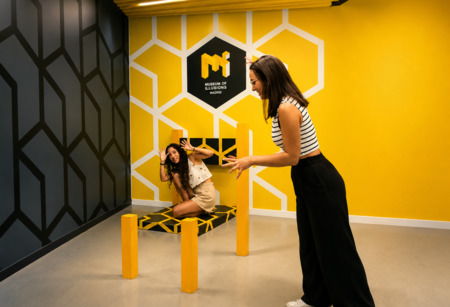
Some of the most memorable experiences await visitors in the museum's immersive rooms. Here, you can step into the famous Ames Room, where, after just a few steps, a person appears to transform from a giant into a dwarf and back again. You can walk through the spinning Vortex Tunnel, which challenges your sense of balance, or explore the Tilted Room and the Reverse Room, where your usual perception of the horizon and direction is completely turned upside down.
Equally fascinating is the Infinity Room, where mirrors create the illusion of endless space. It feels as though the walls have disappeared and the room stretches far beyond its actual boundaries. Few people manage to pass through these rooms quickly. Almost everyone lingers a little longer, eager to test their senses once again or capture a photograph that leaves everyone who sees it wondering how it was possible.
Interactive Installations and Unusual Photo Opportunities

After experiencing the large-scale illusions, your attention shifts to a series of smaller interactive installations where you become part of the exhibit yourself. Here, you can take photographs on the famous Beuchet Chair, where perspective suddenly makes you appear tiny, see multiple versions of yourself at the Clone Table, look into a kaleidoscope, or recreate the famous "Head on a Platter" illusion, which never fails to bring smiles to visitors.
This is where the museum is filled with the most laughter. Some visitors spend time searching for the perfect camera angle, others repeat their favourite experiments again and again, while many simply cannot believe that the photographs were taken without any editing. As a result, a visit to the museum becomes not only an exploration of optical illusions but also an opportunity to take home genuinely unique photographs.
Brain Games and Puzzles
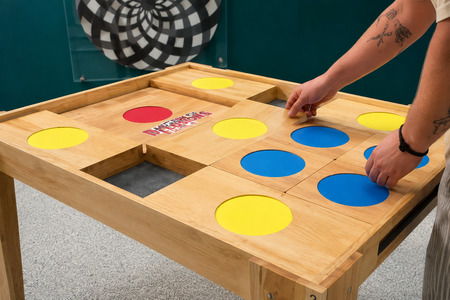
The final part of the museum features a collection of brain games and puzzles. Wooden puzzles, tabletop challenges, optical riddles, and observation exercises offer a welcome break from the striking visual effects, putting your problem-solving skills to the test rather than your eyesight. Some of the challenges seem surprisingly simple at first, yet finding the correct solution on the first attempt is often much harder than expected.
As you leave the museum, you may find yourself looking more closely at even the most ordinary things. It seems incredible that the human brain can reconstruct reality so convincingly, making us see something entirely different from what actually exists. That is the true idea behind the Museum of Illusions — to amaze, entertain, and at the same time reveal just how remarkable our perception of the world really is.
Museum of Illusions Tickets
Several ticket options are available for visiting the Museum of Illusions. You can purchase a standard admission ticket and explore the exhibitions at your own pace, choose a family ticket if you are visiting with children, or reserve a convenient entry time in advance. Combination tickets are also available, allowing you to combine your visit to the museum with other popular attractions and experiences in Madrid, making them an excellent choice for anyone planning a full sightseeing itinerary.
It is advisable to plan your visit in advance, especially if you intend to visit at weekends, during school holidays, or on public holidays. The museum is particularly popular with families, so visitor numbers tend to increase significantly at these times. A typical visit lasts between one and one and a half hours, although many visitors stay longer to explore all the exhibitions at a relaxed pace, solve the puzzles, and take unusual photographs.
What Else to See in Madrid
- Madrid Wax Museum — another unusual attraction where you can take plenty of memorable photographs and see lifelike figures of celebrities, historical figures, and characters from popular films.
- Royal Palace of Madrid — discover its magnificent state rooms, the Throne Room, the Royal Armoury, and the official residence of the Spanish monarchy.
- Prado Museum — one of the world's greatest art museums, home to masterpieces by Velázquez, Goya, Bosch, Titian, and many other renowned artists.
- Santiago Bernabéu Stadium — visit the legendary home of Real Madrid, explore the club museum, and experience the famous Bernabéu Tour.
- Warner Park Madrid — one of Spain's finest theme parks, featuring thrilling rides, live shows, and themed areas inspired by famous films and cartoons.
- Theme Parks in Madrid — an overview of the best amusement parks for both children and adults to enjoy during a trip to Spain's capital.
- Top Attractions in Madrid — discover the Spanish capital's most iconic sights, essential for anyone visiting one of Europe's most beautiful cities for the first time.
- Where to Eat in Madrid and What to Try — discover the best Spanish dishes, local culinary tips, and the best places to sample traditional cuisine in Madrid.

 English
  Español
  Русский